


You stop at a red light, flip down the sun visor and the little mirror catches it in clear daylight. One dark, coarse hair sits under your chin that was not there at breakfast. The tweezers in the glovebox are kept for exactly this moment. Another pair waits by the bathroom mirror, and a third lives in your bag. Laser hair removal for facial hair at MediZen in Sutton Coldfield is how that private routine finally comes to an end.
| Performed by | Appointment | Downtime | Results | Price from |
|---|---|---|---|---|
| Our trained laser team, under the clinical direction of Dr David Eccleston | A few minutes for the upper lip or chin, after a consultation and patch test | None to plan around; mild redness settles within 24 to 48 hours | A reduction after the first session, with a course of 6 to 8 sessions about 6 weeks apart | £99 a session for a small area such as the upper lip or chin |
We use a dual-wavelength laser that combines an Alexandrite beam with a deeper Nd:YAG beam. Pigment in each hair soaks up the light and carries it down to the follicle, the tiny pocket in the skin where the hair is made. The heat that builds there switches the follicle off, while the skin around it is spared and cooled. Sessions are run by our laser practitioners, Laura Gallagher, Laura Valenzano and Jemimah Dela Tetteh among them. Dr David Eccleston, our clinical director, oversees the service.
The clever part is that the laser needs the very root your tweezers keep pulling out. A plucked hair takes its root with it, so there is nothing left in the follicle for the light to find. That is why the first change we ask for comes before any treatment at all. You put the tweezers away and shave instead. We then space sessions about six weeks apart, so each one meets a fresh wave of growing hairs.
Why the Same Hair Keeps Coming Back
Every hair on your face grows from a follicle that stays put after the hair has gone. Plucking, waxing and threading clear the surface for a while, but the follicle simply starts again. That is why the same coarse hair turns up on the same spot of your chin every few weeks. It also explains why years of careful plucking have changed so little, however diligent you have been.
Follicles work in cycles, and only some are actively growing at any moment. The rest are resting quietly beneath the surface, waiting for their turn to grow. A hair you pluck today has a neighbour that will surface in a fortnight, and another behind that. Seen this way, the routine is not a failing on your part. You are dealing with a system that keeps renewing itself on a timetable of its own.
Facial hair in women is far more common than conversation suggests, and its effect on everyday life is well recorded. A study in the Journal of Cosmetic and Laser Therapy measured how much unwanted facial hair weighed on seventy people’s daily lives. After three laser sessions, their scores fell by about two thirds. The tweezers, the visor mirror and the glances at shop windows take more of a day than we admit.
The pattern of your hair is something your clinician talks through at the consultation. Some women have a few stubborn chin hairs, while others notice finer growth spreading along the upper lip, the jaw and the neck. Each pattern responds to the laser, though heavier or more widespread growth can need a few extra sessions. Your plan is built around the hair you actually have.
How the Laser Finds the Root You Stopped Plucking
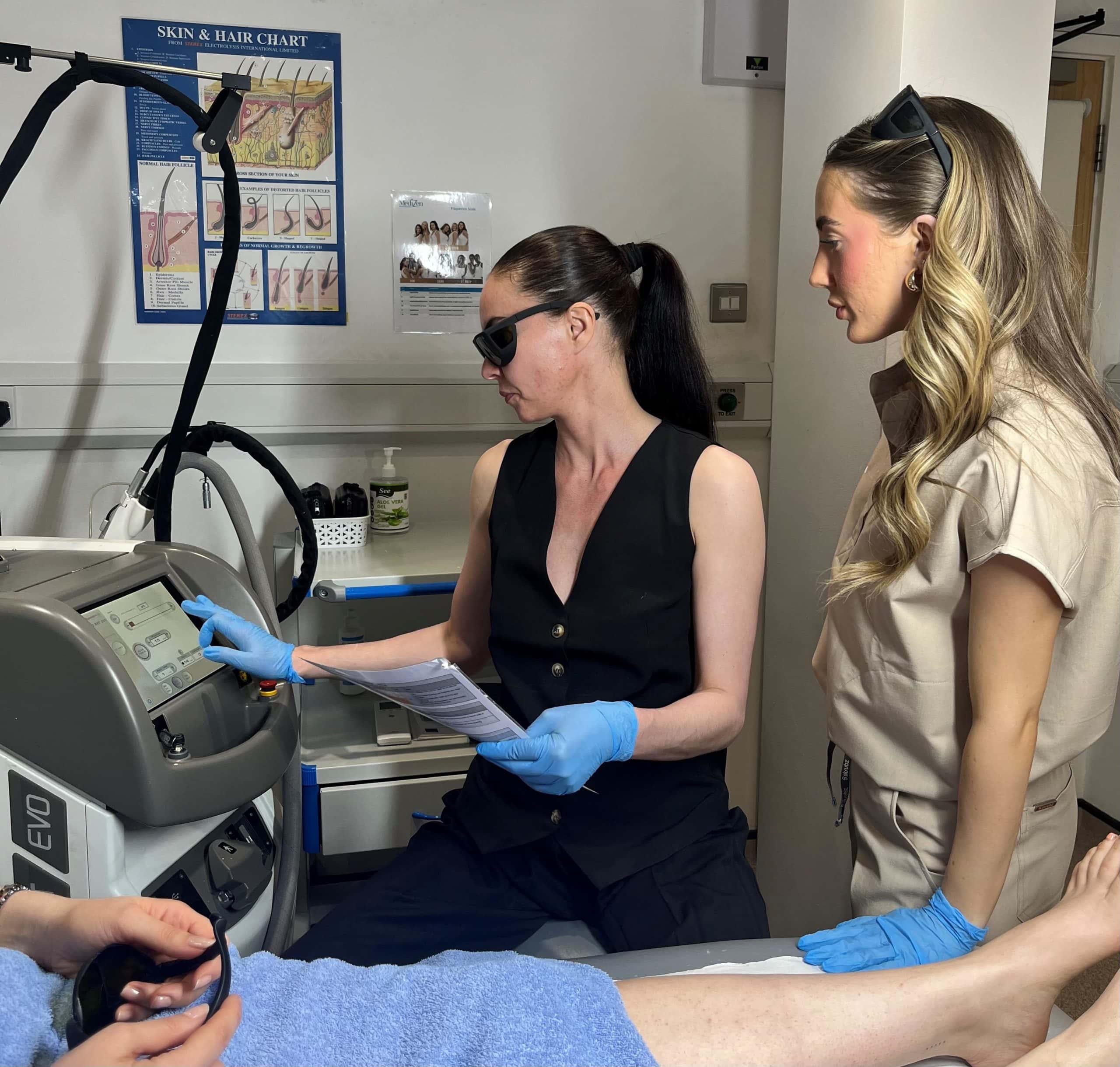
The Alexandrite wavelength, at 755 nm, works quickly and efficiently on finer, lighter brown hair near the surface. The Nd:YAG wavelength, at 1064 nm, reaches deeper and coarser follicles, the wiry kind that favours the chin. It is also gentle on the pigment around the hair, so it treats darker skin tones safely. Your practitioner chooses the balance for your skin at the patch test.
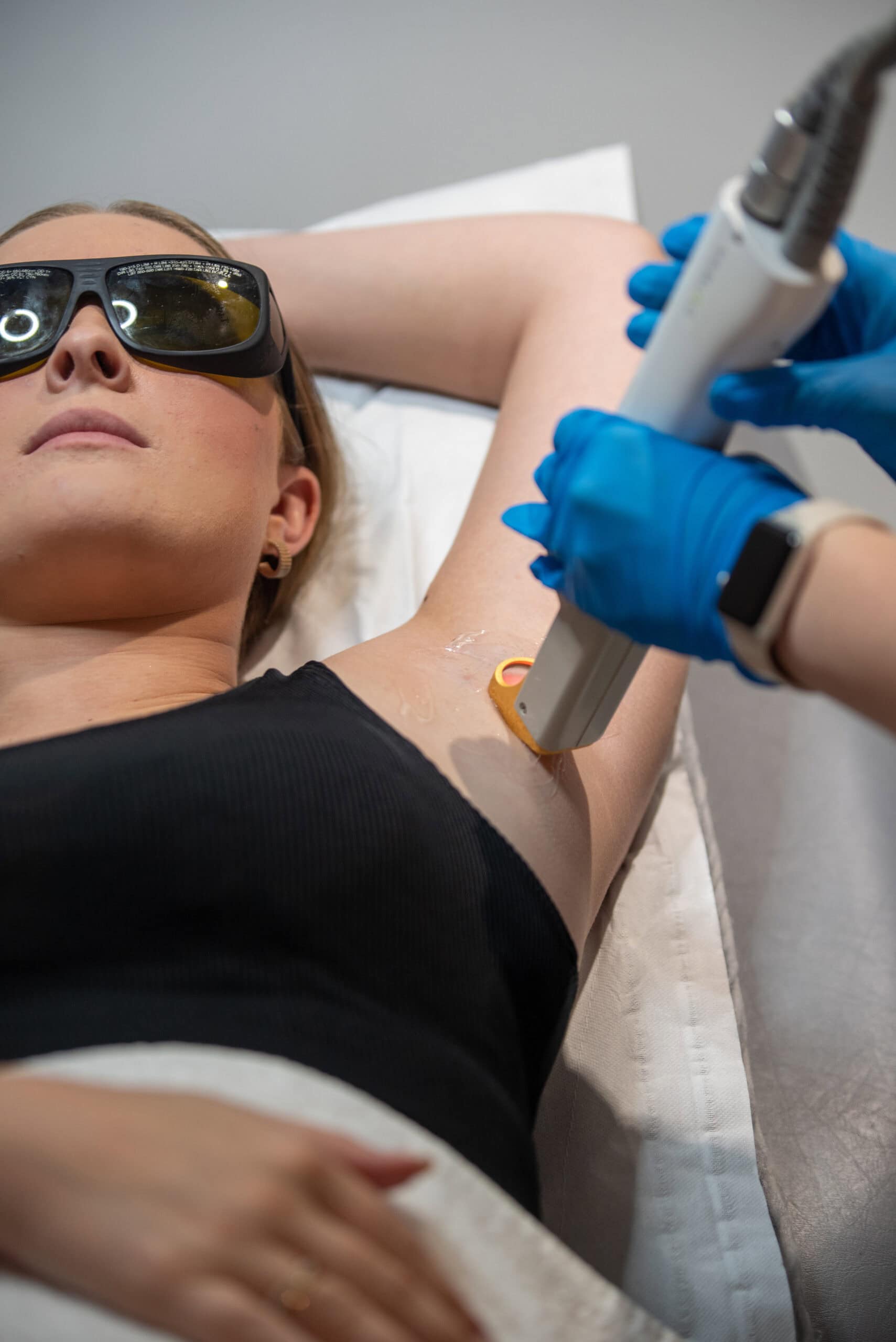
At the appointment both of you put on protective glasses, and photographs are taken for your notes. The handpiece then moves across the skin in rapid bursts, each one followed by a blast of cold air. The sensation is often compared to the snap of a rubber band, warm and over in an instant. Around the eyes themselves we never treat, and the rest of the face gets the same cooled approach.
Facial sessions are short, and an upper lip or chin takes only a few minutes, so an appointment slips easily into a lunch hour or a school run. Shave the area the day before or that morning, so the root stays in place for the light to reach. Waxing, plucking and epilating stop in the weeks beforehand and stay stopped for the whole course.
A Course Planned Around Your Hair and Skin
Dark hairs respond most strongly, since the light homes in on pigment. Blonde, red, grey and white hairs hold very little of it. For those, our team suggests advanced electrolysis, which deals with one follicle at a time whatever its colour. Many women have a mix of both on the face, and a plan can use each method where it suits.
Most women find the hardest part of the course is leaving the tweezers in the drawer between sessions.
Skin needs a little preparation too. After sun or a sunbed, the face needs a four to six week pause before treatment, and fake tan should be gone for about two weeks. Most women find the hardest part of the course is leaving the tweezers in the drawer between sessions. Shaving is the one method we encourage, because it clears the surface in seconds and leaves the root for the laser.
Years of plucking can leave their own traces, such as redness or brown spots from ingrown hairs. As the hair thins, ingrown bumps usually ease because there is far less hair to become trapped. Where marks remain, our excel V+ laser can even them out once your course is underway. Your practitioner tells you whether that is worth adding.
Six Weeks Between Sessions, and What Changes
Straight after a session, the skin often looks a little pink and feels warm. That usually fades within a day or two. Until it does, leave out hot baths, the sauna, workouts and scrubs, and wear sunscreen over the treated patch. Before you go, your practitioner explains the aftercare, and you can call us with any question in between.
In the next week or three, the treated hairs fall out. At first they resemble regrowth, yet they are only loosening from a follicle that has stopped holding on to them. You will notice a reduction after the very first appointment. Each later session thins the regrowth further. By the third or fourth visit, the change is usually plain to see.
A full course is usually six to eight sessions, each about six weeks after the last. Any hairs left afterwards tend to be fewer and finer. An occasional maintenance session keeps the odd one in check. A UK study in Clinical and Experimental Dermatology followed women for up to thirty months after facial laser treatment. The everyday benefits were still measurable at the end, though they eased over time, and the authors concluded that further sessions are what keep them.
Where Your Course Starts
First comes a consultation in person, with a patch test, and neither costs extra. A qualified practitioner reviews your medical history and checks your skin type and hair colour. They also study where and how the hair grows on your face. You leave with a clear plan, a realistic number of sessions and a price. Our article on why autumn suits a laser course explains how sun timing fits in.
One small zone, the lip or the chin, is from £99 per visit, and treating the whole face starts from £175 a session. Monthly memberships spread a course over time, from £90 for a small zone or £155 for the face. You can see every option on our price list and the memberships page.
Our rooms are upstairs at Astor House in Mere Green, close to Sutton Park and handy for Four Oaks, Lichfield and Erdington. Bring the tweezers to your consultation if you like, and our team will show you what a course of laser hair removal can do for the face in that visor mirror.
Facial Laser Hair Removal: Your Questions
Women thinking about laser for the face tend to ask us the same things before they book. These are the questions that come up most, and our laser team will go through any others with you.
Yes, and the face is one of the most common areas we treat, from a few stubborn chin hairs to the upper lip, jaw and neck. The laser works on dark hair, heating each follicle so it stops growing. A course of six to eight sessions about six weeks apart gives a long-lasting reduction, with an occasional maintenance session keeping the odd hair in check.
We treat the upper lip, the chin, the jawline and the neck, alone or together. The only place we stay away from is the immediate eye area. A small area such as the upper lip or chin is priced as one zone, and a fuller face plan covers several areas in a single short appointment. Your practitioner maps the areas with you at the consultation.
Expect a course of six to eight visits roughly six weeks apart, since only actively growing hairs respond to the light. You will see a reduction after the first visit, and the clearest change usually shows by the third or fourth. Heavier growth sometimes needs a few extra sessions, and your practitioner sets realistic expectations at the start.
No, and this is the most important habit to change. Plucking, waxing, threading and epilating pull the root out, which leaves the laser nothing to target at your next session. Shaving is fine and encouraged, because it clears the surface while leaving the root in place. Shave the day before or the morning of each appointment.
Most people find it far more comfortable than they expect. Each burst feels like a quick warm snap on the skin, and cold air follows it at once. The upper lip can feel a little sharper than the chin, but facial sessions take only a few minutes and the sensation passes the moment the laser lifts.
Not well, because the laser targets pigment and blonde, red, grey and white hairs hold very little of it. For those hairs our team recommends advanced electrolysis, which treats each follicle individually regardless of colour. Many women have a mix of dark and fair hairs on the face, and a plan can combine the two methods.
Yes. Our dual-wavelength laser includes an Nd:YAG wavelength at 1064 nm, which reaches the follicle while bypassing much of the surrounding pigment in the skin. That makes it suitable across darker skin tones. Settings are matched to your skin at the consultation, then checked with a patch test before the whole area is done.
Our Sutton Coldfield prices start at £99 per visit for one small zone, like the lip or chin, and £175 for the whole face. Memberships begin at £90 or £155 a month for those two options. Your consultation and patch test cost nothing extra, and the exact price is agreed at that first visit.
The result is a long-lasting reduction rather than a promise that no hair will ever return. After a full course the treated area usually stays smooth for a long time, with the odd fine hair surfacing over the years. An occasional maintenance session deals with those, and your practitioner talks through the pattern of your growth so you know what to expect.
Give the Tweezers a Rest
If the visor mirror keeps finding the same hairs, talk to our laser team in Mere Green about a facial course. You can reach the clinic on 0121 308 4373, or drop us a WhatsApp and we will book your consultation and patch test.
 Back