



Tonight, before you brush your teeth, press your palm flat across your forehead and try to raise your eyebrows. They barely move, and you feel the muscle under your hand straining to lift them. That muscle is the only one in your face that raises the brows. The horizontal lines above them are the trace of a lifetime of lifting. At MediZen in Sutton Coldfield, our anti-wrinkle injections ease those forehead lines and leave the muscle enough strength to keep doing its job.
| Performed by | Appointment | Downtime | Results |
|---|---|---|---|
| Doctor or independent nurse prescriber, under the lead of Dr David Eccleston | Minutes, with no anaesthetic | None, your day carries on as planned | Lines soften from 3 to 5 days, complete at around 2 weeks, holding 3 to 4 months |
Treatment means a few small, carefully judged doses of a prescription-only, muscle-relaxing medicine, given with a very fine needle. At MediZen a doctor or an independent nurse prescriber plans every dose and places every point. Leading the service is Dr David Eccleston, whose work with anti-wrinkle treatment spans nearly thirty years. He also trains the injectors who work with him at the clinic.
The clever part is how lightly the forehead needs treating. A measured dose eases the muscle’s pull just enough to stop the skin folding so deeply. The brows still rise when you are surprised or pleased, and the skin above them simply creases less. The first change appears after three to five days. At around two weeks the forehead looks smoother in daylight, and your eyebrows still move when you want them to.
The Only Muscle That Lifts Your Brows
The frontalis is a broad, thin sheet of muscle running up from the eyebrows into the scalp. Each time you widen your eyes, read small print or show interest in a long meeting, it contracts and draws the brows upwards. The skin over it cannot shorten, so it folds into bands that run from temple to temple. You repeat that movement many thousands of times a year without noticing.
Working against it is a small team of muscles that pull the brows down and together. They include the corrugators and the procerus between the eyebrows, and the ring of muscle around each eye. A review of frontalis anatomy in Aesthetic Plastic Surgery describes a good result as a balance between these opposing pulls. It also recommends tailoring the dose and placement to each face.

In your twenties those folds disappear as soon as the brows come down. Collagen thins a little every decade, and years of sunlight speed that up. The lines start lingering after the expression has gone, first under strong overhead light and later in the gentler light of home. Some people lift their brows almost constantly, often when the upper lids feel heavy, and their lines tend to arrive earlier. None of this is a fault in your routine. It is simply a muscle that has worked hard.
Why a Frozen Forehead Is Really a Dropped Brow
The frozen look people fear comes from taking away too much of the lift. Relax the frontalis heavily and the muscles that pull downwards win the balance. The brows settle lower than you are used to, the upper lids feel hooded, and the forehead looks smooth but heavy. That flat, slightly tired expression is what most people mean by frozen, and it comes from a heavy hand.
Placement matters as much as the amount. A randomised trial in Plastic and Reconstructive Surgery compared three ways of treating the forehead and measured the brows each time. Every pattern softened the lines. Injections across the middle of the forehead lowered the brows more, while those placed higher up kept the brows where they were. The lesson is technical, and it is also very reassuring.
Smooth is easy to achieve, and the skill lies in deciding how much lift to leave behind.
Smooth is easy to achieve, and the skill lies in deciding how much lift to leave behind. Your practitioner treats the forehead as the muscle that holds up your brows, not just as a surface with lines on it. Small amounts go where the creases form. Enough strength is left in the lower part of the muscle to keep the brows open and expressive.
A Forehead Plan That Keeps the Lift
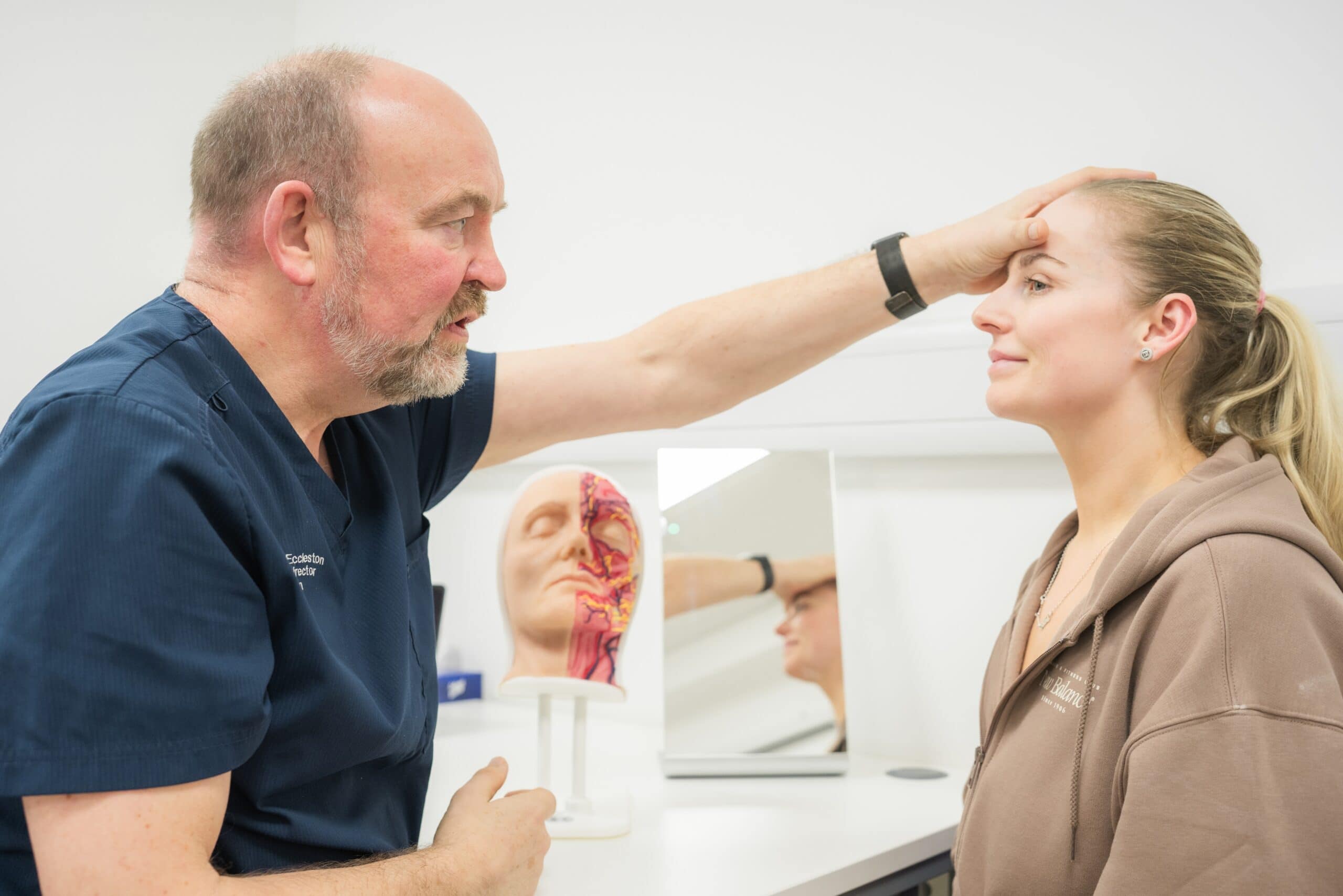
Your appointment starts with you raising your brows, frowning and smiling while your practitioner watches. They note where your lines sit, how high your brows rest and how strongly the muscle pulls. A high, expressive forehead needs a different map from one where the brows already sit low. Where the brows are low to begin with, the plan uses less and places it higher, and your practitioner explains why.
Treating the frown lines between the brows is often part of the balance. Relaxing the muscles that pull down supports the brows while the forehead softens above them. Our before and after gallery shows forehead and frown lines photographed at two weeks. The overall effect is a face that looks well rested, which is quite different from a face that has stopped moving.
Some forehead lines are etched deeply enough to show at complete rest. Relaxing the muscle softens these rather than erasing them, and your practitioner says so at the start. Where the skin itself has thinned or lost its bounce, we often add a treatment for skin quality. Profhilo and polynucleotides improve hydration and firmness in the skin above the muscle. The surface looks smoother while the movement beneath is gently eased.
The Weeks After, With Your Brows Still Moving
The appointment lasts a few minutes, with a handful of tiny injections and no anaesthetic. Most people feel a brief sting and nothing more, then return to their desk, the shops or the afternoon pick-up. Written aftercare comes with you. For the rest of that day, keep your head up for a few hours and your fingers off your forehead. Hard workouts, saunas and facials can wait until the next day.
From around the third day, raising your brows gathers the skin into softer folds. By about two weeks the change has settled, and the forehead looks smoother under office lights and in the car mirror. You can still lift your brows in surprise. Your forehead still creases a little when you laugh hard. The arch of the brow stays where it was, and the deep tramlines stop dominating the face.
The smoothing lasts about three to four months, before the lines drift back as the muscle wakes up. Plenty of people book a top-up every three or four months so the forehead stays fresh. Regular visits also stop the creases carving deeper each year. Over time the muscle tends to lift a little less hard between appointments, which helps the skin above it keep its smoothness.
Where Your Forehead Plan Starts
Because the medicine is prescription-only, your forehead plan begins in person, with a medical assessment by a MediZen doctor or nurse prescriber. Your practitioner reviews your health and watches your forehead in motion. You talk about the expressions you want to keep as much as the lines you want softened. If another approach would suit your skin better, you hear that plainly before anything is booked.
Forehead treatment starts from £235, and adding the frown lines or crow’s feet at the same visit is common. The current figure for every area is on our price list, alongside memberships that spread the cost of regular visits. The full detail of each area sits on our anti-wrinkle injections page.
Our clinic in Mere Green is on Lichfield Road, handy for Four Oaks, Little Aston and Walmley. If you have put off treating your forehead lines because you love your expressions too much, come and talk it through. Your practitioner will show you exactly how much lift your brows need, and how the forehead treatment keeps it there.
Your Questions About Forehead Lines
Anyone who wants a smoother forehead without losing their expressions tends to wonder about the same few things. Here they are, answered plainly, and anything else gets a full reply at your consultation.
Through a measured dose placed in the right part of the muscle. Your practitioner eases the frontalis just enough to stop it folding the skin so deeply, and leaves enough strength in its lower fibres for your brows to lift naturally. The lines soften over a fortnight, and your forehead still moves when you are surprised or amused.
They come from the frontalis, the only muscle that lifts your eyebrows. Each time you raise your brows to read, listen or react, the skin above them folds. Over the years, thinning collagen and sun exposure let those folds stay visible at rest. People who lift their brows often, without realising it, usually see the lines earliest.
A dropped brow comes from relaxing the frontalis too heavily or in the wrong place, which is exactly what careful planning avoids. Your practitioner checks where your brows rest and how strongly they lift, then places small amounts higher on the forehead. Treating the frown lines at the same time often helps the brows stay open.
Raising your brows gathers the skin into softer folds from around day three to five. The result is complete at about two weeks, which is when MediZen photographs its before and after pairs. There is no downtime along the way, so work, exercise from the following day and evenings out carry on as normal.
About three to four months, after which the muscle gradually regains its strength and the lines start to return. Many people book a top-up every three or four months, which suits the natural rhythm of the result. Treating regularly also keeps the creases from carving deeper, so the forehead tends to look smoother between visits.
They soften, though a line etched deeply enough to show when your face is still will not vanish completely. Relaxing the muscle stops it deepening, and the skin gradually looks smoother. For more refinement we often add Profhilo or polynucleotides to improve the skin itself, and your practitioner explains which pairing suits your forehead.
Expect a brief sting at each point rather than real pain. The needle is very fine, each injection takes a second and no anaesthetic is needed. It all takes a few minutes, and you can go straight back to your day with nothing more than a few tiny marks that fade quickly.
Prices at MediZen in Sutton Coldfield start from £235. Your total depends on the areas you choose, such as the forehead alone or the forehead paired with the frown lines. Memberships spread the cost for regular visits, and your practitioner confirms the price at your consultation. The current figures are on our price list.
A doctor or an independent nurse prescriber, every time. Dr David Eccleston, our Clinical Director, leads the anti-wrinkle service and trains the injectors who work with him. Whoever you see has learned the same light touch, which is why the aim is always a rested, natural forehead rather than a dramatic change.
Keep the Lift, Lose the Lines
If your forehead lines bother you but your expressions matter more, come and see the team led by Dr David Eccleston in Mere Green. Call 0121 809 3183 or send a note through WhatsApp, and we will find a consultation time that works for you.
 Back