

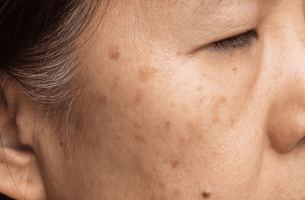
If age spots and sun spots have started appearing on your face, hands or chest, you are far from alone, and the good news is that they are among the most treatable forms of pigmentation we see. At MediZen, our doctor-led team in Sutton Coldfield has spent years helping people across Birmingham and the Midlands fade these flat brown marks safely. Below we explain what causes them, why laser works so well, and how to keep them from coming back. You can also explore our full pigmentation treatment in Birmingham hub for an overview of every option.
What are sun spots and age spots?
Sun spots and age spots are the same thing under two different names. Doctors call them solar lentigines. They are flat, well-defined patches of brown or tan pigment that sit near the surface of the skin, ranging from the size of a freckle to around a centimetre across. They tend to have a clear edge rather than fading gradually into the skin around them.
Despite the name, age spots are not really about age. They are a record of the sun your skin has absorbed over a lifetime, which is why they show up most on the areas that catch the most light: the cheeks, forehead, backs of the hands, forearms, chest and shoulders. Many people first notice them in their forties and fifties, though they appear earlier in anyone who has spent a lot of time outdoors or on sunbeds.
These marks are almost always harmless, but any spot that changes shape, colour or size, or that itches or bleeds, should be checked by a doctor rather than treated cosmetically. As a CQC-registered, doctor-led clinic founded in 1999, MediZen starts every consultation with a proper assessment of what your marks actually are.
Why does sun exposure cause them?
Your skin makes a pigment called melanin to protect itself from ultraviolet light. When UV reaches the skin, cells called melanocytes produce more melanin, which is what a tan really is. Over years of exposure, some of these cells overproduce pigment in concentrated spots that clumps together near the surface. The result is a discrete, darker patch that stays put long after any tan has faded. Because the trigger is UV, sun spots keep forming throughout life unless the skin is protected, which is why prevention matters just as much as treatment.
Why age spots and sun spots respond so well to laser
Here is the reassuring part. Because sun spots are concentrated pigment sitting in a clearly defined patch, they are an excellent target for laser. Our excel V+ laser, a Cutera system delivering precise 532nm and 1064nm wavelengths, is designed to be absorbed by exactly that pigment.
The light passes harmlessly through the surrounding skin and is soaked up by the melanin in the spot. That energy breaks the pigment into tiny particles that your body clears away naturally. Because the mark is discrete and well-defined, the laser treats it with real accuracy while leaving the clear skin around it untouched.
The same excel V+ laser that clears sun spots and age spots also handles freckles, and its 1064nm wavelength treats facial redness, thread veins and other vascular concerns. You can read more on our excel V+ laser in Birmingham page.
What laser treatment feels like, and the timeline
Most people are surprised by how quick and straightforward the treatment is. A handful of spots can often be treated in a short appointment, usually with no need for numbing cream, though we can apply it for more sensitive areas. As the laser pulses over each spot, most people describe a warm, light flick, a little like the snap of an elastic band. There is no real downtime, and you can return to normal activities straight afterwards. Here is what to expect over the following days:
- Straight after treatment, the spots usually look darker, almost like tiny specks of coffee grounds. This is a good sign that the pigment has absorbed the energy.
- Over the next few days the treated marks may feel slightly rough or crusty. It is important not to pick or scratch at them.
- Within about one to two weeks, these darkened flakes lift away on their own, taking the pigment with them and revealing clearer skin underneath.
Many sun spots clear noticeably after a single session, though deeper or more stubborn marks can need a second treatment. Your practitioner will give you a realistic plan at your consultation rather than a one-size-fits-all promise.
How sun spots differ from melasma
This distinction matters, because the two are often confused and need very different care.
Sun spots are discrete: individual, well-defined marks with clear edges, which is exactly why targeted laser works so effectively on them. Melasma is diffuse. It shows up as larger, blurry patches, often symmetrically across the cheeks, forehead or upper lip, and it is driven by hormones and heat as well as light. Crucially, aggressive laser can make melasma worse rather than better.
For melasma we take a gentler route, combining laser toning with our Xeo+ laser in Birmingham and a carefully built skincare routine. If you are not sure which you have, that is completely normal, and it is one of the first things we clarify in your consultation. Getting the diagnosis right keeps treatment both safe and effective.
Preventing sun spots from coming back
Laser can clear the pigment you have today, but it cannot switch off the sun. Because ongoing UV creates these marks in the first place, daily protection is the most important step in keeping your results.
- Wear a broad-spectrum SPF 30 to 50 every day, even when it is cloudy, as UV also passes through windows.
- Reapply through the day when you are outside, and add a hat and sunglasses in strong sun.
- Support your skin with the right actives. Antioxidants such as vitamin C and pigment-regulating ingredients can slow new spots from forming, and our team can build a routine using medical-grade skincare in Birmingham.
- Consider a course of chemical peels in Birmingham to keep the skin surface bright and even between laser sessions.
Think of it as clearing and then protecting. For a full overview of your options, our pigmentation treatment in Birmingham hub brings everything together in one place.
Frequently asked questions
Are sun spots and age spots the same thing?
Yes. They are two everyday names for the same marks, which doctors call solar lentigines. They are flat patches of concentrated pigment caused by years of sun exposure, most common on the face, hands and chest. The different names simply reflect that people link them with either sun or ageing, but the cause is the same.
How many laser sessions will I need to remove age spots?
Many discrete sun spots fade significantly after a single excel V+ session, especially on the face and hands, though deeper or stubborn marks may need a second treatment. At your consultation we give you a realistic plan rather than a fixed promise, because everyone’s pigment behaves a little differently.
Will my sun spots come back after treatment?
The spots we treat are cleared, but new ones can form if the skin keeps absorbing UV. This is why we never describe results as permanent and why daily broad-spectrum SPF is so important. With good sun protection and the right skincare, most people keep their skin clear for a long time.
Can laser treat melasma the same way it treats sun spots?
No, and this is a key point. Melasma is a diffuse, hormone-influenced pigmentation that can worsen with aggressive laser, so it needs a gentler approach such as laser toning combined with skincare. Sun spots, being discrete and well-defined, are far better suited to targeted laser like excel V+.
 Back
Back